Wednesday, September 1, 2010

Songpan, July 25-26

Back in Nanjing! It's gonna take a while to post all the blog entries I have written on our epic journey - I hope you'll bear with me :)

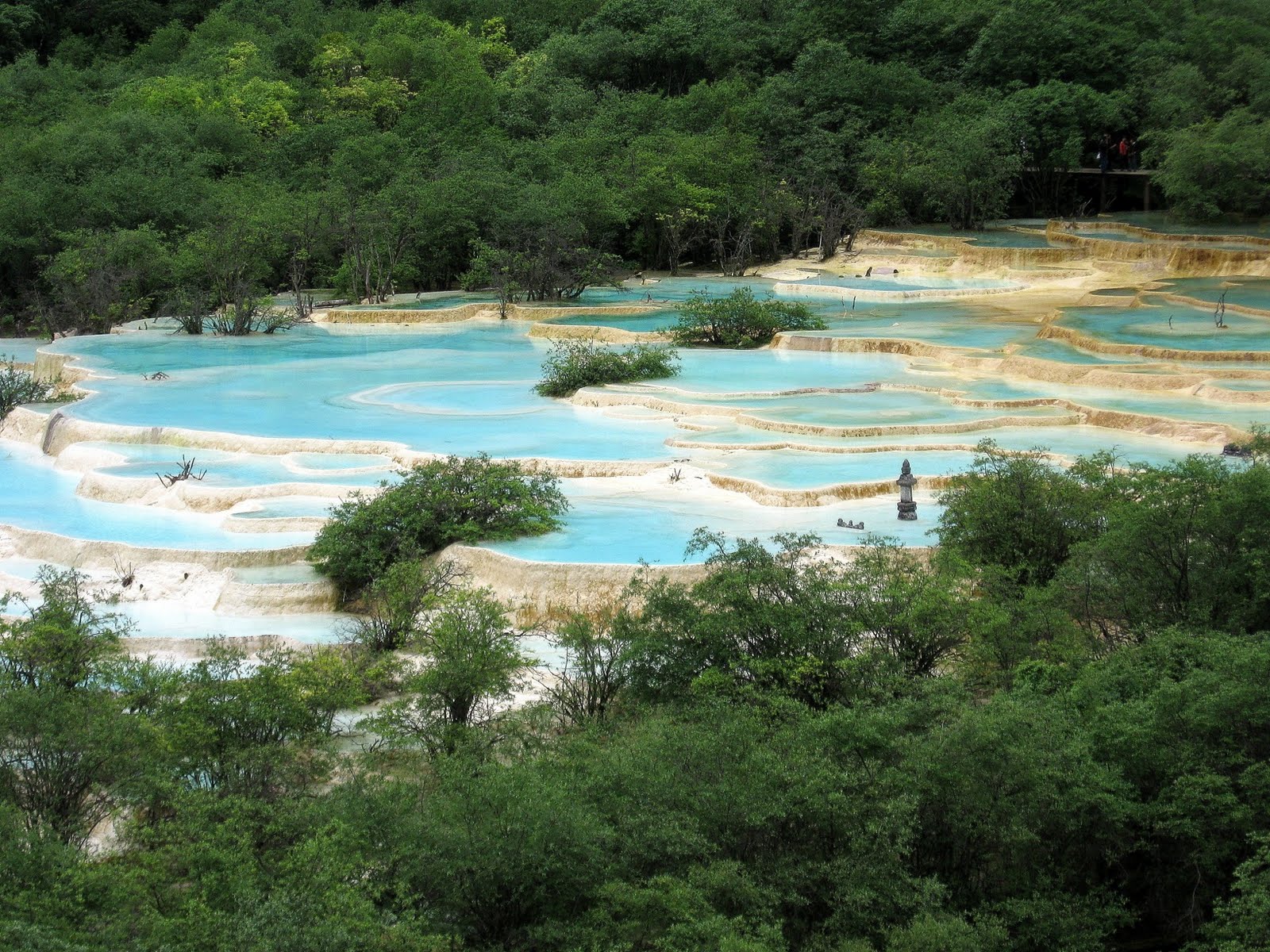
This place is totally over-hyped. Supposedly it's so cute, so historic (all fake, the city wall is full of kitsch statues of guards and reproductions of catapults). It's a "gateway" to Jiuzhaigou and Huanglong Parks, but the roads are so bad (through mountains and under construction) it takes over two hours to get there. We only went to Huanglong, because Jiuzhaigou is supposedly even more crowded. To do both just seems like more of the same and they both charge considerable entrance fees (200yuan and more). Huanglong means Yellow Dragon and the name is due to the yellow limestone sediments that wind along a valley like a long Chinese dragon... ok, you need quite a bit of fantasy to see the dragon shape. But the limestone forms pools in all shades of yellow, orange, brown and the water in it has all shades of turquoise - it's really pretty. Whenever a log, root or some other natural barrier is covered with the lime stone sediment it forms an edge and altogether they make for this web of natural terraces. It has to be seen to be believed. The Unesco thought the same and declared it a World Heritage Site (we're starting to realize just how full of those China is), which means your usual good infrastructure, bus loads of tourists and high prices. Sadly, you can only follow a board walk and not roam around by yourself, but given what we saw other tourists do - throw around litter, climb over fences - it seems very necessary to preserve the park. I hate to sound judgmental, but Chinese make really terrible, inconsiderate tourists. No respect for the environment. The park's high entrance fee is probably due to the hoards of garbage collectors they employ.

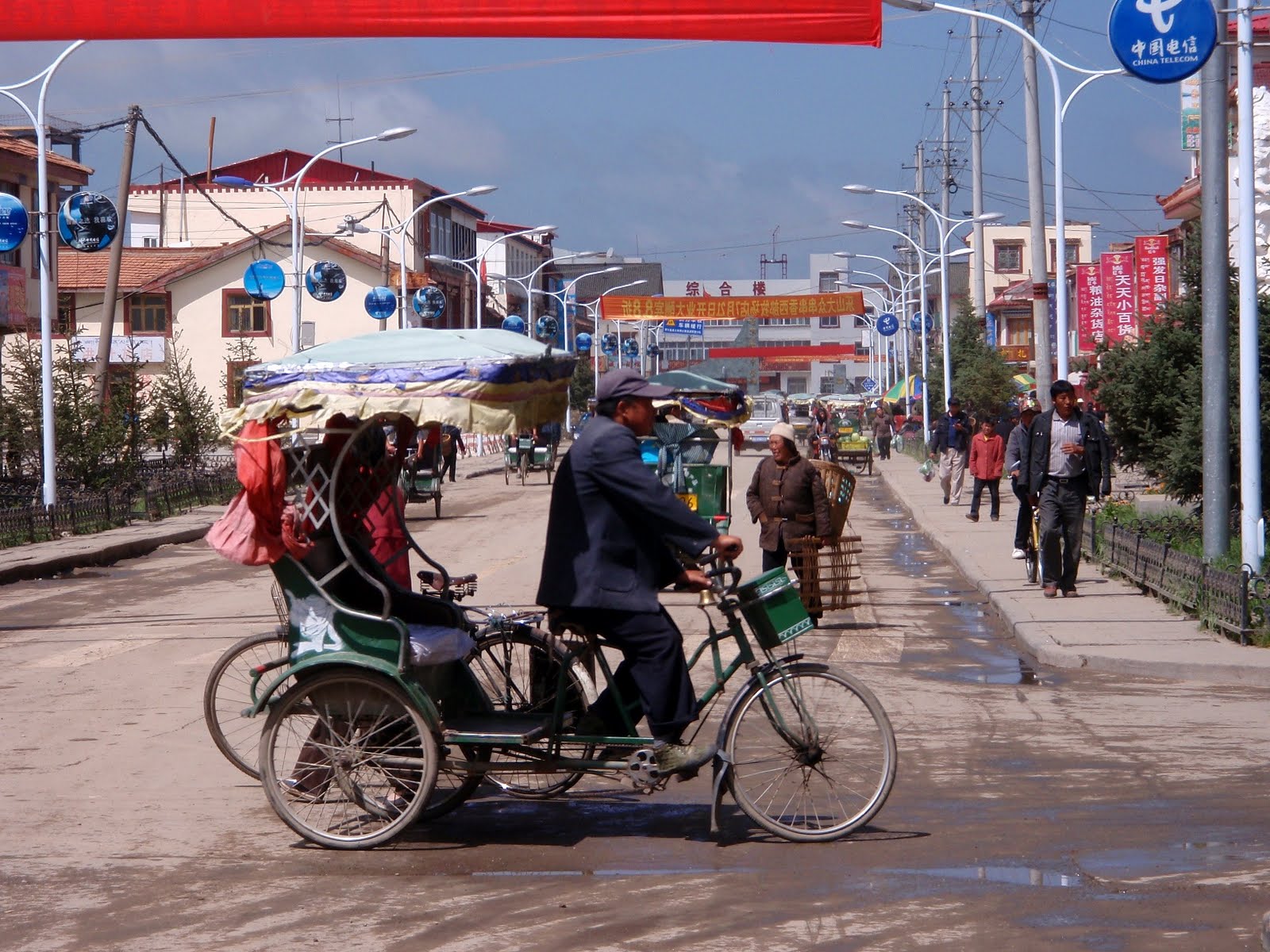
Songpan is also famous for offering horse treks - but B. declined :) There's a pedestrian street in the center, but it mostly has shoe stores. And on the outskirts they are building "New Songpan," it looks as if it will double the number of inhabitants once it's occupied. All in all, absolutely not worth the torturous bus ride. But it's nice to eat some Chinese food for a change! What's the hype with all the Tibetans? Their food is miserable and everything smells like yak butter! Why always Tibet, Tibet, Tibet??? Is it so strange if a tourist in China actually wants to see Han Chinese things and eat Chinese food? The Lonely Planet seems to think so. On the other hand, their guide book for Bangkok recommends you go to Chinatown there... notice a theme?

Saturday, August 28, 2010

Zoiige (Ruo'ergai), July 24

We got stuck here, because we believed the Lonely Planet that to make it from Langmusi to Songpan one needs to stay overnight. Well, it turns out they changed the bus schedule so that one can take the 7am bus to Zoiige and from there the 10am or 2:30pm bus to Songpan - but we found out too late. But whatever. It was entertaining in the sense that they really don't seem to get many tourists there, let alone foreigners. In the restaurant where we had lunch they couldn't stop giggling, even after I managed to successfully communicate with them in Chinese, they just couldn't get over themselves. One waitress was so afraid of us, she refused to come to our table and would send her colleague over instead. Just after we arrived, we opened the laptop to look on a map and immediately a crowd of 10 or so people surrounded us, talking animatedly about what the laowai were doing. They were helpful, though, and pointed us to the bank. When we had lunch in a hot pot restaurant (not bad) and B. went to the bathroom, I immediately had the neighboring table crowding and interrogating me. The usual "where are you from? How old? What do you do? Married? Kids?" So much for small talk... Several people felt obliged to welcome us "to China" :) Much nicer than the usual crowd trying to sell us stuff or rip us off. There was genuine curiosity, and although I wouldn't like to be the town's curio attraction every day, it was a nice change for once.

The most exciting event was actually my second phone interview, this time in a really crappy but nevertheless horrendously pricey hotel room (walls with mold stains and a filthy bathroom for 480RMB=$80!) Again, I was quite nervous, but I got the job! So, starting November, I will be interning with Tostan in Washington DC, an organization you should totally check out, I am very excited about their ideas and approach. Maybe I should start a new blog - "Academic goes NGO" or something like that - and inspire hordes of frustrated physicists to leave research and take up non-profit work :) I can already see it - being single-handedly responsible for the downfall of string theory because they run out of (wo)manpower :-P Wouldn't that be something?

Tuesday, August 24, 2010

Langmusi, July 21-23

Seems I have to eat my own words... small villages with muddy roads and open sewage can indeed be charming. I can't explain what's so much nicer about Langmusi that I actually enjoy staying here - I guess to a large extend it's the people. They do get quite a few tourists here, because it's on the road from Xiahe to Songpan, two rather famous places, and they also have two monasteries and a mosque that are worth a visit. Still, people seem rather unspoiled and natural. for some reason, they marvel at digital cameras and always want to have their picture taken - I am not sure what the great appeal is of seeing yourself on the display of the camera. It's not that they want a picture with us or of us (although that happened too), most of the time they ask us to photograph them.


Langmusi sits directly at the border of two provinces, a small stream divides the village into Gansu and Sichuan side. It's surrounded by what looks like rolling hills but are actually 3,600m high mountains. We are at over 3,000m in the village itself. No altitude sickness so far although physical activity is more streneous than usual. We opted out of the suggestion of a 2-day hike to the highest mountain and did a one-day horse trek instead, which seemed the more relaxing thing to do. Well, I enjoyed it a lot, but I think B. would have preferred to walk :) His horse seemed to be a donkey in disguise, never went where it was supposed to. We had lunch at a nomad family tent,
but it wasn't quite as romantic as it sounds - they just left the food there for us and went outside, we ate together with our guide, who wasn't really so much of a guide. Because of us being foreigners, he restricted his commands to "hello!" (meaning we were going in the wrong direction) and "ok, ok!" All my attempts at engaging him in a Chinese conversation didn't make things much better, although we did understand each other fairly well.

The village is surrounded by grasslands with myriads of flowers, it's indescribably beautiful. We rode to the spring of the Tiger River, the stream that supplies Langmusi with water. And while the water is clear and fresh up at the spring and probably drinkable quality, the further down you get to the village the more garbage it contains. And scarily, people wash their clothes and food right in the center of the village where the water is the dirtiest. Some guide books actually seem to find that romantic. Any leftover food is also simply thrown in the ditch. We could witness some "green energy" use, however - solar powered water kettles :)

Right now is festival time for the Tibetan monks, so they get to go out from their monastery and sit around on the grasslands, having picnics, relaxing in tents. We walked by a Tibetan nomad couple who were just hanging out in the grass and motioned us to come over and sit with them. The woman (hung with jewelery and dressed in traditional Tibetan skirt, which is wrapped around the waist, sits very high, and is held by a huge silver-decorated belt) didn't speak any Mandarin at all, the man about as much as I :) We still figured out they wanted pictures taken, even with us, and they actually want us to send them to them, which is rather non-trivial, as they don't seem to have an address. A youth on his colorful motorbike (clearly a horse-surrogate, the men here like to drape colorful blankets over their motorbikes as if they were saddles) came by and offered his address. I can't really read his handwriting, but once back in Nanjing I'll figure out a way to mail the pictures.

The only annoying thing (apart from the power outage in our guesthouse, but at least cell phone reception was great, because I had my first phone interview for my internship here) are the Sichuan monks who are real lay-ways. They claim the path one needs to take to get to the Tiger gorge goes through their monastery, so they charge an entrance fee, even if you only want to go hiking. The gorge is gorgeous (hah!), it was a bit crowded when we went on a sunny day, maybe due to the festival. It also looks a bit like full of garbage but those are shawls, usually in white and yellow, presented as an offering to the Buddha (or tiger?) There are also huge piles of wooden spears. We were told it's because this festival commemorates the arrival of Buddhism - some monk told the fighting nomads of the grasslands to give up their weapons, so they piled them all on a mountain and burned them ("gave them back to God").

And best of all - in Langmusi there's good food, Tibetan as well as Sichuan, so we finally got some veggies, but also the Tsampa (Barley stuff) here tastes good. And there's wireless internet in two places! It's a nice place to just hang out and relax. It's a bit cold for my taste, never really above 20 degrees, I miss the desert :) As I type this I'm sitting in a little cafe run by a couple of Tibetan sisters (recognizable by their jewelery, straight noses and language, of course). One is sitting next to me and we chat a little with our limited Mandarin. She's also leaning over trying to see what I type but admits she doesn't recognize anything. Tibetan script looks kinda cool, but I can't make out a single word. That might be how she feels about English. And as you can see, our laptop attracts a lot of attention :)

Monday, August 16, 2010

Xiahe, July 18-20

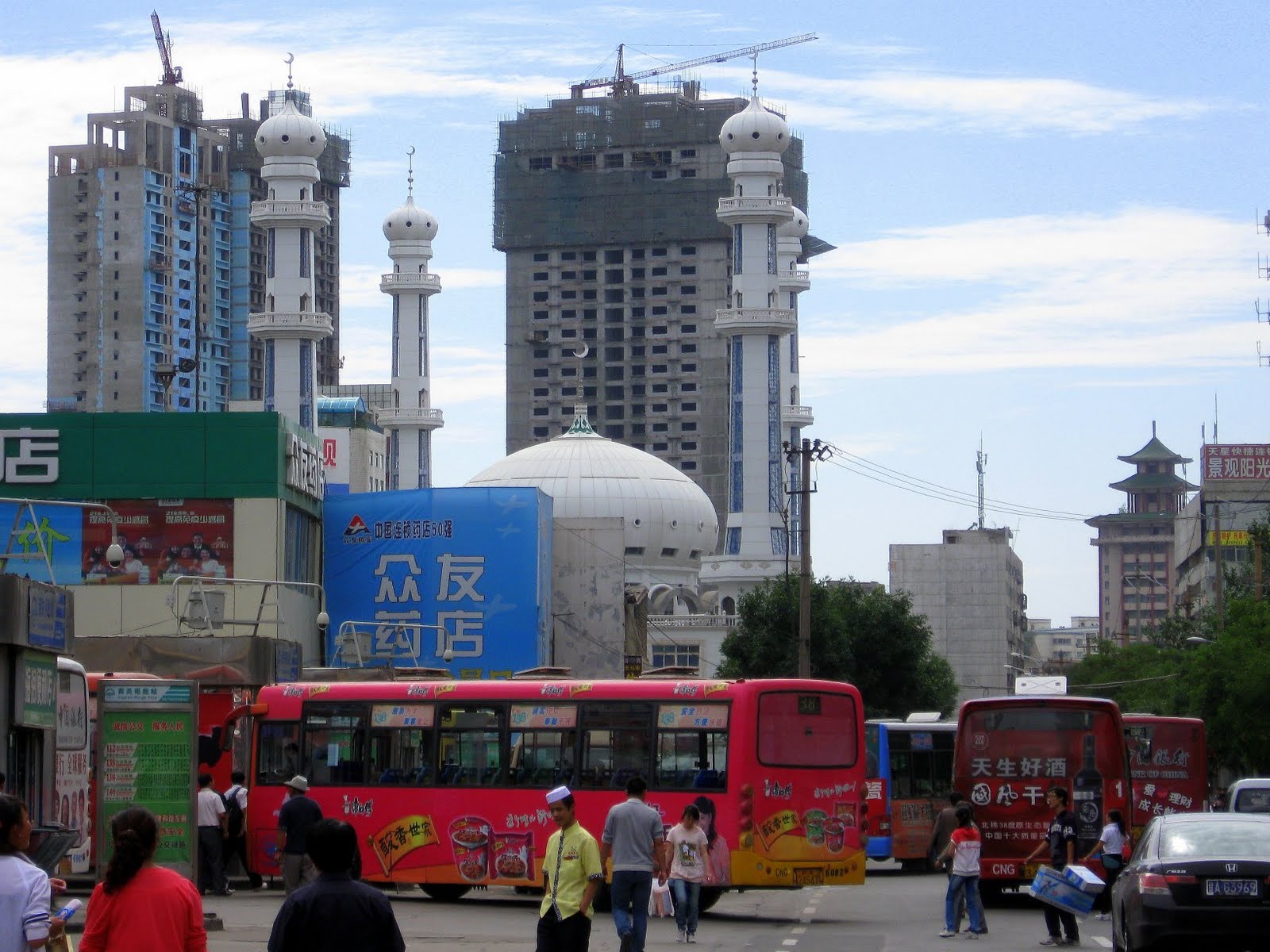
The bus ride from Lanzhou was really interesting, because the first couple of hours we drove through mostly Muslim areas - I have never seen so many mosques in my life, every village seemed to have at least two. Often they are a mixture of Chinese and oriental architecture - for example a six-corner pagoda, made from wood beams with typical chinese patterns, topped by a large golden dome with the half-moon. The further south we got, the more we saw Tibetan Buddhist temples (recognizable by their prayer flags).

Xiahe, a tiny town consisting of only one muddy street inhabited by Han at the eastern end, Tibetans at the western end and Muslim Hui in the middle, is home to the Labrang monastery - one of the six major monasteries of the Yellow Hat sect (only two are outside Tibet). It was founded in 1709 and housed 4,000 monks during its prime time. During the cultural Revolution they suffered some setbacks, but were able to preserve a lot of their temples. Today, they teach Buddhist Philosophy, Medicine and other fields at six colleges. Right now they have about 1,200 monks living there. Pilgrims walk the "kora" - the pilgrim's path around the monastery - from dawn till dusk and keep turning prayer wheels. One can visit the inside, but only with a guided tour and no pictures allowed - except for the Yak butter sculpture museum -
and yes, that's just as weird as it sounds. Yak butter is also used as fuel for lamps throughout all the temples, which makes for a rather interesting smell, and as a condiment for tea, bread and pretty much anything else it seems (my theory is that it also serves as body lotion, which would explain the smell of people).

The town has a very strange vibe to it. The - without exception - crappy looking hotels are all booked out, the main street is bustling with monks in red robes and Tibetans (starring cowboy hats and large knives), a lot of them pilgrims. I don't feel any of the friendly "vibe" the Lonely Planet talks about. The men are extremely rude in staring, as far as just sitting next to me in a tea house and trying to read what I am writing on a postcard or typing on the laptop. Everyone - Han, Hui or Tibetan - is trying to rip us of, trying to sell us water for 5RMB (normal price 2RMB) or not giving me any change at the bus station in the hope I wouldn't be able to read the bus ticket (I even suspect the man in the post office!) Maybe I'm failing to grasp the Tibetan Romanticism that seems to have struck all the other western tourists here, who walk around with glowing faces and buy cheap silver jewelery. This place could be really nice, it's nestled between mountains (we're at 3,000m here) and today there is a beautiful clear sky and crisp air (quite cold after Dunhuang). But all the garbage piles on the side of the street and the fact that there is construction going on everywhere - the last two items seem to describe almost ever town in China - spoils it quite a bit. Right now the main street is torn open left and right, possibly to lay sewage pipes (the rest of the village obviously does not have a sewage system, there's only a ditch on the side of the road and everyone - man, woman, pig - just pees on the street). I can already see how this place will become another Disneyland type Eldorado in a few years. But frankly, I fail to see the charme in small towns that have never undergone any "beautification" - at least in China. I hate myself for saying that, but the average Chinese village seems to be an unattractive heap of dirt and garbage (piled on the side of the street and set on fire from time to time). Maybe I'm just conditioned to Europe's "small town romanticism" - I failed to find Newfoundland pretty just as well - but I can be charmed by small Italian or French villages that have nothing special to offer apart from a pretty setting. But China fails to charm me... I guess I'm having quite a downer after two weeks on the road. Maybe I need a break.

Special food - everything made of yak, from yak meat over yak milk and yoghurt to yak butter (which is also put in tea and tastes slightly salty). Tsampa - a porridge of roasted barley. Rice with sugar in yak milk (tastes kinda buttery). A "cake" made from yak butter and wheat flour with red beans(?), which is more like cookie dough, didn't seem baked at all. Supposedly there's momo - boiled dumplings, but what we had was rather steamed, and most certainly not fresh. The Tibetan diet seems almost veggie-free, I'm dying for somehting green and leafy. It's all very dry and starchy, mixed with milk or yoghurt (which is really good, I admit).

Dunhuang, July 13-17

Realizing we had seen what there is to see in Jiayuguan (and more), we decided to cut our stay there short and head on to Dunhuang - a famous oasis town on the Silk Road. After a quite hazardous 5 hour bus ride (during which we miraculously had to switch buses, which was not planned) with a driver who treated the dashed line in the middle line as a target line and always centered the bus on it - honking angrily at the opposing traffic which forced him into the right lane, and the most aggressive cab drivers at the bus station - they actually tried grabbing and pulling us to their cars - we checked into a Tang-dynasty style hotel, which has several courtyards, a "castle" and the rooms are decorated with folk art and have stone floors with oriental carpets on them. Again, it seems to be planned for hundreds of people, who have miraculously failed to show up.

Dunhuang is most famous for Mo Gao Ku, or Thousand Buddha caves - this is a cave complex about 20km outside of town, which literally contains thousands of Buddhas. At its peak the site housed 18 monastries and over 1400 monks and nuns - according to the Lonely Planet. Wealthy traders would donate money to create new caves, to pray (or give thanks) for a safe journey across the west. After the first cave was created in 366AD, this became a real hype until the end of the Yuan dynasty, when the complex was sort of forgotten. Every cave contains several Buddha statues and immense wall paintings, which are amazingly well-preserved. The place became really famous after a Taoist monk discovered a huge forgotten library of Buddhist scriptures in a cave. Unfortunately, he sold most of it off to foreign explorers (German and French), and when you take a guided tour through the caves (the only way to visit, you can't just wander around on your own) they don't fail to point out what has been stolen by Americans- they often removed wall paintings by chizzling off the top layer of stone. Most impressive is a 35m high sitting Buddha, which used to be housed in a 4-storey temple, so that its head would look out of the roof. When it was restaurated during the Qing(?), the building got another 5 storeys, so the Buddha is now completely covered. Unfortunately, the outside of the cave complex has a loveless wall from the 60s (it looks like 60s, too), but they needed to stabilize the walls because of frequent earth quakes. The caves are also protected by doors (with numbers on them), so that I couldn't help but feel it looks like a prison... a Buddha prison :)

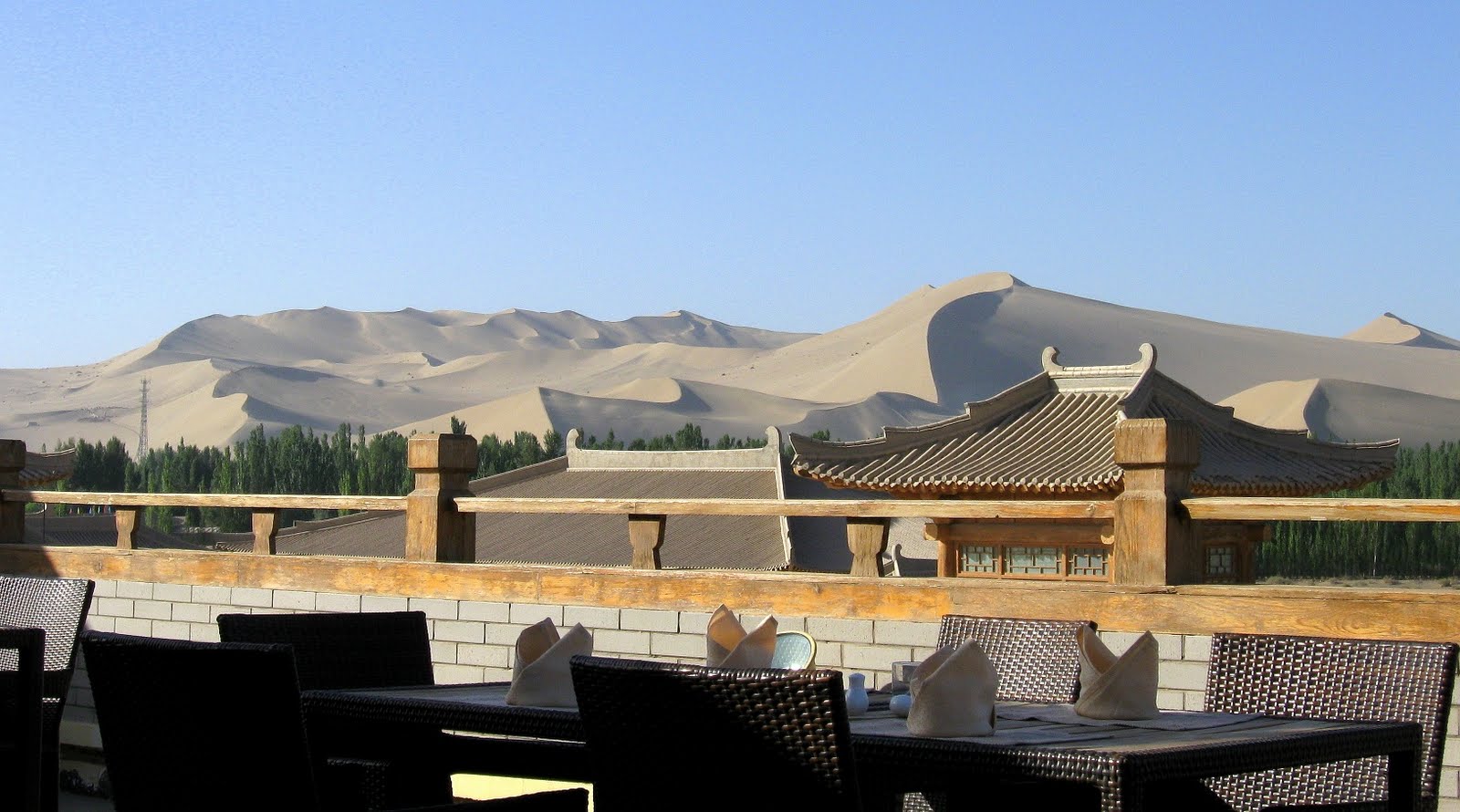
Although popular with tourists, Dunhuang is not crowded and people are quite laid-back, so that we seldom got harassed by vendors. They gentrified city center is also rather small, so you don't feel lost like in Jiayuguan. Some pedestrian streets make it a nice place to stroll and we enjoyed the peace and quiet of the town so much that we stayed longer and mostly just hung out, either on our rooftop cafe (where I submitted my internship application! :)) or in the streets where all the restaurants have tables outside. It's unbearably hot here during daytime, probably reaching 40 degrees, and with the huge sand dunes (Mingshan is 1700m high) in the background one gets a real desert feeling. Since that was not enough, we also went on a 3-day camel ride through the desert.

We started off at 6pm, since it was an especially hot day, starting from our guide's house - Li Shifu (he's also a shifu, but not like my kungfu teacher, he's the skilled-expert kind of shifu) has been doing these kind of tours for almost 30 years. Whereas we came prepared with sunscreen, hats, long (white) clothes and sunglasses, he just set off with a bunch of keys and his cell phone, looking as if he was just going around the corner buying cigarettes. As soon as we had reached the sand dunes, he took off his shoes and walked barefoot, leading Fang Fang, my new best smelly friend for the next few days, on a rope, who was tied to Le Le (our pack camel) and Lin Lin, whose one hump was kinda sagging because her "yin/yang has problems". Unfortunately, the first evening we were joined by a youth camp group of 15 American teenagers and a couple of annoying guys in their twenties who kept trying to impress the teachers. But they went back into town the next morning and we were left alone with Li Shifu and three camels.

Fun part about the desert - watching the sun set over the dunes, with the oasis of Dunhuang in the distance. Not so much fun - getting up at 5:30am to watch the sun rise at 6:30... Why we were woken so early I'll never know, but we were on our way by 7, to avoid the main heat. After not too long the sand became to hot for our guide to walk on, so he tied some sturdy, bright orange platic bags around his feet. These "shoes" also serve as anchors for pretty much anything, from tent to camel, when filled with sand. We also had to rest between 11:00 and 17:00, because it's just too hot.

The desert was surprisingly green - quite a lot of shrubs grow in the sand, which the camels like to chew. Those are really hard branches they bite off and chew down - just to re-chew them the whole day. Supposedly, they can go 10-20 days (depending on heat and desert condition) without food or water, but they were clearly hungry on the second day and tried to grab whatever they could when we passed by. During our siesta the camels were allowed to roam around freely and eat what they liked. They ventured off pretty far, but Li Shifu managed to get them all back. After another night in the desert we got back to his home early the next morning.

And after another hazardous taxi ride to the nearest train station with frequent trains, we're on another night train - back to Lanzhou, from where we have to switch to bus to make our way south across one of the Tibetan autonomous Prefectures, into Sichuan. It's precisely this Tibetan region which after our visit was devastated by mud-slides that killed hundreds of people... about three weeks after we passed through there.

Sunday, August 8, 2010

Jiayuguan, July 12-13

There is only one reason to come here and that's the Great Wall - this is where it all ended, the western most point of the Wall under the Ming dynasty. Jiayuguan has a fortress, which was named UNESCO World Heritage Site in 1987. This seems to have prompted the city to massively invest in tourism, there's a huge park around the fortress, the nearest parking lot is about a km from the entrance, so you first have to make your way through vendors selling mostly knick-knacks, don't expect any food (which we needed badly after biking the 15km there from the city against heavy wind), it seems they learned from the Terracotta warriors... just that the tourists aren't coming. The place was almost empty when we went there, the vendors looked bored, the buggy drivers (who drive you from the parking lot to the fortress) idle... It seems to be the story of the town - abandoned construction sites everywhere, huge avenues, roundabouts with socialist style sculptures in the middle - but no-one there to use it! Almost no traffic to speak of, even in rush hour there's no traffic jam, you almost always get a seat on the bus... Jiayuguan - where socialist living is fun!

The same went for our hotel, but they were friendly and clearly happy to practise the two or three English sentences they knew. They thought we were crazy when we asked to rent bikes though. Thankfully, the Lonely Planet does contain some useful information, and we managed to rent two bikes and ride out to the end of the wall - a place 5km out of town where the Ming Wall suddenly ends at a steep river cliff... it could be a quite impressive sight if it wasn't for the Disney-like fort they built there. It's not even a museum or of any historic or educational value! There are a few fake cannons next to catapults and you can have your picture taken in a supposedly historic costume - if the only keeper of the place shows up. Because, of course, the place was deserted. More abandoned construction projects nearby and blue construction fences that spoil the yellow-brown desert imagery... Disappointed, we rode of in the direction of the fortress, and the best part was probably when we just decided to leave the road and ride through the brush. In the end, we did have to turn back and make our way to the big parking lot. The fortress is quite impressive and just as we got there, a huge storm started. Looking west from the fortress walls, one looks into the Gobi desert, where caravans used to depart for an uncertain journey...

In the evening we wanted to see the sun set over the wall, so we hired a taxi for a round trip. He said he'd wait for us for about half an hour. Poor B. ran up the stairs to the watch tower to see the red sunshine on the snow covered mountains - I had to pass, after only little sleep on the train and the day's bike trip I wasn't running anywhere (also the height, around 2,000m seems to take its toll on my fitness), so we wouldn't let the taxi driver wait too long. Well, when we came out he had left! We hadn't paid him yet, not even half of the agreed fare! So, there we were, a good 10km out of town, and there was nobody else in sight (it was already after 9pm, they had opened the gate for us after our taxi driver talked to the gate keeper). We didn't quite know what to do, we felt bad for "cheating" our driver out of his fare, but when a taxi happened to pass by, we didn't hesitate long and hailed it. Who knows when there would be another one? The driver asked rather perplexed "how did you get out here?" Still no idea what happened to our first driver... too bad we didn't know he had abandoned us, we could have stayed at the wall longer. Without any other tourists around - I wish I could have that experience at the Great Wall stretch close to Beijing - the wall there is much more imposing, several meters high and wide enough for a horse cart. The wall stretch we visited falls into the "is it still restoration or already fake?" category. The fake camel caravan (statues) didn't exactly help...

We did spend half a morning wandering around the market, trying strange fruit and tasty baked goods. People are friendly (they are Hui - Muslim Han Chinese, so not really an ethnic minority - recognizable by the white hats worn by men) and probably quite dumbfounded what brings foreigners to their city. Well... so were we.

Friday, August 6, 2010

Lanzhou, July 9-11

This time we had the soft sleeper car (the difference is not actually the firmness of the berth but the degree of privacy - in soft sleeper cars only four people share one compartment and it has an actual door, whereas in hard sleeper the compartment is open to the hallway - the reason we didn't get much sleep last time, some people went on talking till 1am, others got up at 6... you have to admire the ability of people to make themselves at home in a train car though - they started setting up makeshift tables and playing cards and everybody seems to travel with an inexhaustible supply of raamen noodles, which left us feeling like amateurs with our peanuts... not much for a breakfast when the train is two hours delayed. We abandoned our initial strategy of taking late trains (as we're late sleepers) and arriving not too early and switched to the Chinese schedule - going to bed at 11 and getting up at 6. And it's amazing how much you can get done in a day when you get up at 6 - once we get to the hotel, have showered, had a tea and are relaxed a little it's around 9 or 10 and we have the whole day ahead of us. Admitted, not the fittest of days, at least in my case.

We left Xi'An in pouring rain and arrived in Lanzhou in pouring rain. We were soon consoled, though, because we happened to have picked a really nice hotel (buying train tickets two days in advance and booking hotels on elong seems to work very well) for little money and got upgraded to a room with huge double bed, free standing bathtub and extra shower and all the little knickknacks (like bathrobes, fluffy slippers) you'd expect in a five-star hotel (no idea how many stars they had). A hot foam bath after a night on the train is heavenly :) The hotel also had a really nice decor, full of natural stones, and traditional furniture whose style varied on different floors. The service was over-the-top amazing, which had the effect that we couldn't just wander off somewhere, because someone with a secret-agent style headset would run over to us and ask if we needed help. They even had working internet!

So, we set off to explore Lanzhou, supposedly China's most polluted city - a title I doubt but we might just have had luck with the weather, with umbrella's borrowed from our super-hotel and went in search of a tea house to sit, snack, write and read. The one the Lonely Planet mentions didn't exist anymore, but it was surprisingly easy to find a tea house, i later noticed Lanzhou seems to be full of them. That was a life-time experience :) Not so much in terms of the tea (pretty bad) and food (typical buffet) or decor (kitschy but fitting), but the people! When we got there at 11:30 it was still pretty quiet, but then elderly people started to trickle in and when the lunch buffet was opened at noon there was a stampede to get to the best food (mostly the shrimp) - all-you-can-eat is also very popular in China. 15min later the bowls were wiped clean. One old lady liked the food so much, she took her denture out of her mouth and licked it clean.

The sun started coming out. We left the battle field and headed out into the city, which is really like any other Chinese medium-sized (a few million inhabitants) city, but if you haven't seen one, then how can you know what I'm talking about? Basically, there is a "gentrified" downtown with western style shopping malls and chains like McDonalds and KFC. In smaller side streets you get the cheaper clothes and accessories and the not-yet-gentrified streets typically have grocery or fruit stores, household goods or shoe stores, and street food or noodle shops on the ground floor, with 5-6 storey apartment buildings (probably from the 60s) behind them.The cleanliness and smell of these areas seems to be correlated with the amount of tourists the city gets - Xi'An was the nicest so far (at least inside the city walls), followed by Nanjing, Lanzhou, Jiayuguan. And the farther west we get, the more likely we run into really old neighborhoods without sewage system or even running water (in Lanzhou we witnessed people getting water with plastic containers from a little shed, which I suppose contains a well). Now, I'm all for preserving the old Hutong neighborhoods with the traditional courtyards, such as in Beijing, but those were really just brick huts, more barracks then courtyards. Not far from there new 20-30 storey apartment buildings are growing and I guess it's just a matter of time until those huts are gone - but how are those people supposed to afford living in the new high-rises? It's not like their land now is worth a lot, it's not downtown Beijing, where it's a good deal for the government to give the Hutong residents apartments in the outskirts of town and convert their old homes into museums or tear them down to erect shopping malls (or olympic facilities).

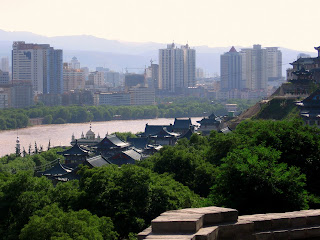
Anyways, after we had made our way through the shopping district and across the Zhong Shan (Sun Yat'sen) Bridge, a masterpiece of Russian-German-Chinese engineering spanning the Yellow River, we climb the hill on the other side, leading to the White Pagoda Park. From there we had amazing views onto the city.Ok, the city is really not amazing, but it's squeezed between two mountain ridges, which gives it its weird, long-stretched form. It was kinda cool to sit in a tea house on top of the hill, which belongs to the Taoist temple, and hear the call of the Muezzin from the Minaret below... There are definitely more Muslims in Lanzhou than in Xi'An or anywhere in eastern China I have been so far, and we expect to see more the further west we get. Also, ethnic minorities become more and more visible, because of their clothing and facial features.

Since we had so much fun eating lamb skewers on the night market in Xi'An, we tried the same thing in Lanzhou - but the night market mentioned by our guide books had already been gentrified. Since it was already quite late, we headed for the nearest noodle shop on a quite dingy-looking unpaved street - after business the restaurants just piled their garbage in the middle of the road. Well, I don't know if you can see where this is going, but the next day we both came down with pretty bad food poising. The second time noodle soup with fried egg was the culprit! I was knocked out so badly, I spent all day in bed - good thing we had booked two nights in our fancy hotel. The hotel service was really attentive (invasive?), they called and asked why we had the "do not disturb" sign outside all day (actually, it's an electric sign, the switch also disables the door bell, so you are completely left in peace... well, until they call you to see if you're not doing anything "illegal, like sex" - quote from the hotel brochure - in your room. when I explained that I was sick, they came and brought me a hot-water bag and "red soup" - a sort of herbal tea, Chinese medicine. I felt somewhat better the next day, but I think that was mostly due to the Western medicine.

The last day we had booked another night train, so we still had a day to kill. None of us felt much like eating, and so we took the cable car up on the other mountain range. The little temple mentioned by the guide books has been expanded into a full-blown park with a fake waterfall and several more pagodas, playgrounds and makeshift tea houses. It seemed still halfway under construction and the large unconcealed garbage heaps here and there were quite a turn-off. But great views...

Noteworthy food - red Chinese dates (Jujube), soaked in wine and served with honey as a cold starter. Tea is often a mixture of green tea with flowers, dried fruit and rock sugar - the same stuff that is sold in Canada (and other places in the west?) at "My Cup of Tea" chain stores... And I always thought they had made this up! Apparently, it's just Western Chinese (or "Muslim" or "8 treasure") tea, I have never seen it in the east. Usually restaurants serve Dragon Well (from Hangzhou) or Bi Luo Chun tea (from Nanjing!)