 Realizing we had seen what there is to see in Jiayuguan (and more), we decided to cut our stay there short and head on to Dunhuang - a famous oasis town on the Silk Road. After a quite hazardous 5 hour bus ride (during which we miraculously had to switch buses, which was not planned) with a driver who treated the dashed line in the middle line as a target line and always centered the bus on it - honking angrily at the opposing traffic which forced him into the right lane, and the most aggressive cab drivers at the bus station - they actually tried grabbing and pulling us to their cars - we checked into a Tang-dynasty style hotel, which has several courtyards, a "castle" and the rooms are decorated with folk art and have stone floors with oriental carpets on them. Again, it seems to be planned for hundreds of people, who have miraculously failed to show up.
 Dunhuang is most famous for Mo Gao Ku, or Thousand Buddha caves - this is a cave complex about 20km outside of town, which literally contains thousands of Buddhas. At its peak the site housed 18 monastries and over 1400 monks and nuns - according to the Lonely Planet. Wealthy traders would donate money to create new caves, to pray (or give thanks) for a safe journey across the west. After the first cave was created in 366AD, this became a real hype until the end of the Yuan dynasty, when the complex was sort of forgotten. Every cave contains several Buddha statues and immense wall paintings, which are amazingly well-preserved. The place became really famous after a Taoist monk discovered a huge forgotten library of Buddhist scriptures in a cave. Unfortunately, he sold most of it off to foreign explorers (German and French), and when you take a guided tour through the caves (the only way to visit, you can't just wander around on your own) they don't fail to point out what has been stolen by Americans- they often removed wall paintings by chizzling off the top layer of stone. Most impressive is a 35m high sitting Buddha, which used to be housed in a 4-storey temple, so that its head would look out of the roof. When it was restaurated during the Qing(?), the building got another 5 storeys, so the Buddha is now completely covered. Unfortunately, the outside of the cave complex has a loveless wall from the 60s (it looks like 60s, too), but they needed to stabilize the walls because of frequent earth quakes. The caves are also protected by doors (with numbers on them), so that I couldn't help but feel it looks like a prison... a Buddha prison :)
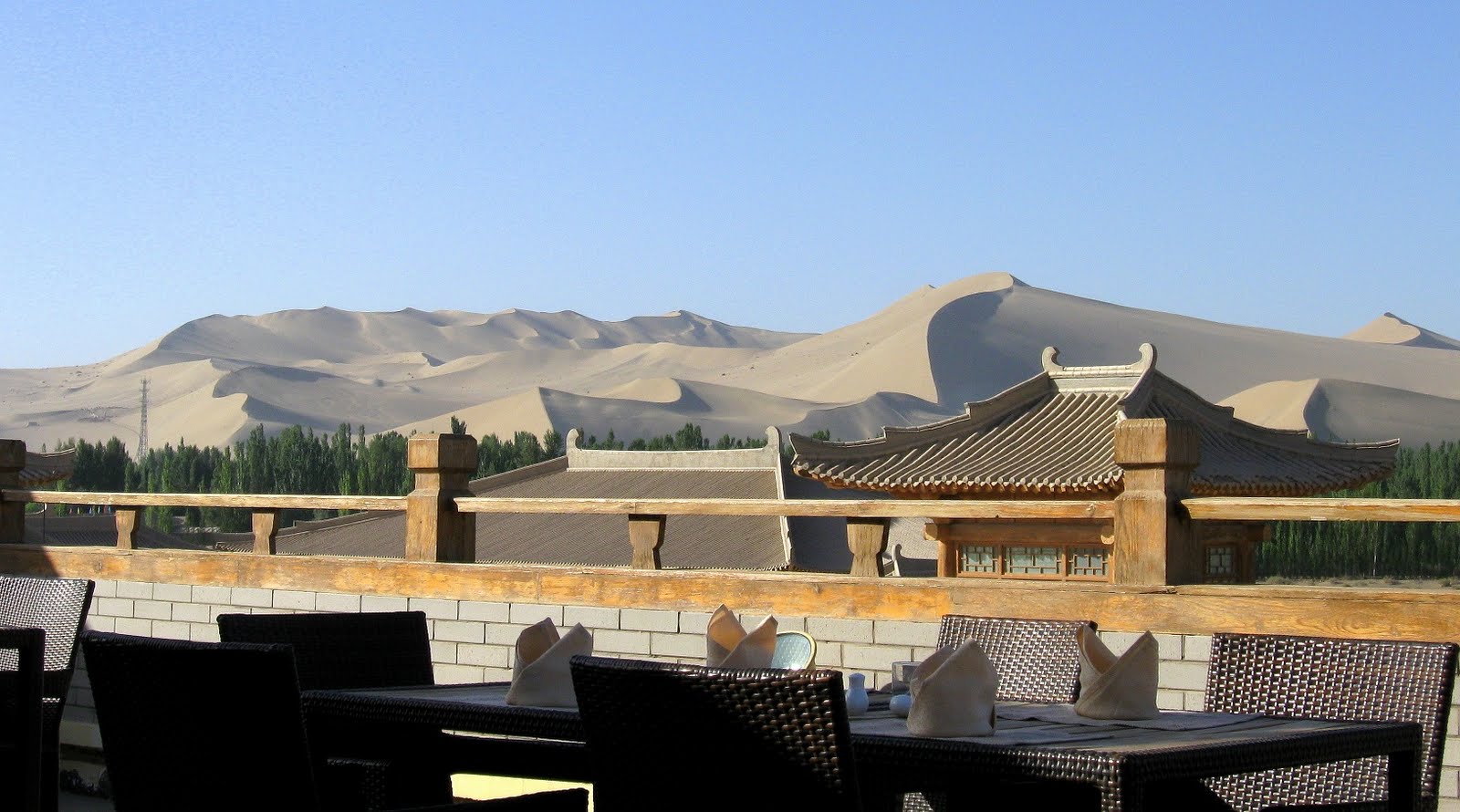 Although popular with tourists, Dunhuang is not crowded and people are quite laid-back, so that we seldom got harassed by vendors. They gentrified city center is also rather small, so you don't feel lost like in Jiayuguan. Some pedestrian streets make it a nice place to stroll and we enjoyed the peace and quiet of the town so much that we stayed longer and mostly just hung out, either on our rooftop cafe (where I submitted my internship application! :)) or in the streets where all the restaurants have tables outside. It's unbearably hot here during daytime, probably reaching 40 degrees, and with the huge sand dunes (Mingshan is 1700m high) in the background one gets a real desert feeling. Since that was not enough, we also went on a 3-day camel ride through the desert.
 We started off at 6pm, since it was an especially hot day, starting from our guide's house - Li Shifu (he's also a shifu, but not like my kungfu teacher, he's the skilled-expert kind of shifu) has been doing these kind of tours for almost 30 years. Whereas we came prepared with sunscreen, hats, long (white) clothes and sunglasses, he just set off with a bunch of keys and his cell phone, looking as if he was just going around the corner buying cigarettes.
 As soon as we had reached the sand dunes, he took off his shoes and walked barefoot, leading Fang Fang, my new best smelly friend for the next few days, on a rope, who was tied to Le Le (our pack camel) and Lin Lin, whose one hump was kinda sagging because her "yin/yang has problems". Unfortunately, the first evening we were joined by a youth camp group of 15 American teenagers and a couple of annoying guys in their twenties who kept trying to impress the teachers. But they went back into town the next morning and we were left alone with Li Shifu and three camels.
 Fun part about the desert - watching the sun set over the dunes, with the oasis of Dunhuang in the distance. Not so much fun - getting up at 5:30am to watch the sun rise at 6:30... Why we were woken so early I'll never know, but we were on our way by 7, to avoid the main heat.
 After not too long the sand became to hot for our guide to walk on, so he tied some sturdy, bright orange platic bags around his feet. These "shoes" also serve as anchors for pretty much anything, from tent to camel, when filled with sand. We also had to rest between 11:00 and 17:00, because it's just too hot.
 The desert was surprisingly green - quite a lot of shrubs grow in the sand, which the camels like to chew. Those are really hard branches they bite off and chew down - just to re-chew them the whole day. Supposedly, they can go 10-20 days (depending on heat and desert condition) without food or water, but they were clearly hungry on the second day and tried to grab whatever they could when we passed by. During our siesta the camels were allowed to roam around freely and eat what they liked. They ventured off pretty far, but Li Shifu managed to get them all back. After another night in the desert we got back to his home early the next morning.
And after another hazardous taxi ride to the nearest train station with frequent trains, we're on another night train - back to Lanzhou, from where we have to switch to bus to make our way south across one of the Tibetan autonomous Prefectures, into Sichuan. It's precisely this Tibetan region which after our visit was devastated by mud-slides that killed hundreds of people... about three weeks after we passed through there.


