Monday, August 16, 2010

Xiahe, July 18-20

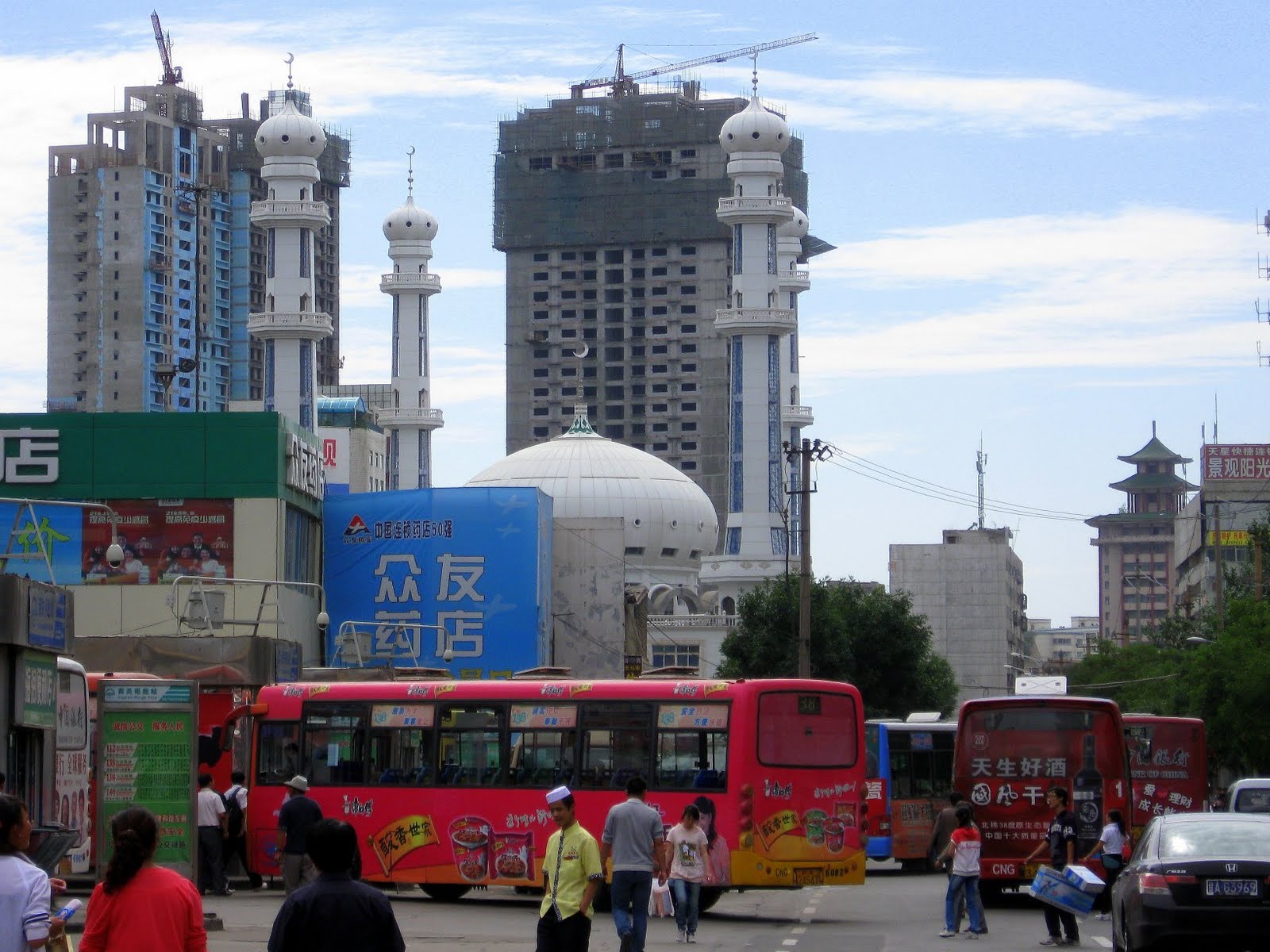
The bus ride from Lanzhou was really interesting, because the first couple of hours we drove through mostly Muslim areas - I have never seen so many mosques in my life, every village seemed to have at least two. Often they are a mixture of Chinese and oriental architecture - for example a six-corner pagoda, made from wood beams with typical chinese patterns, topped by a large golden dome with the half-moon. The further south we got, the more we saw Tibetan Buddhist temples (recognizable by their prayer flags).

Xiahe, a tiny town consisting of only one muddy street inhabited by Han at the eastern end, Tibetans at the western end and Muslim Hui in the middle, is home to the Labrang monastery - one of the six major monasteries of the Yellow Hat sect (only two are outside Tibet). It was founded in 1709 and housed 4,000 monks during its prime time. During the cultural Revolution they suffered some setbacks, but were able to preserve a lot of their temples. Today, they teach Buddhist Philosophy, Medicine and other fields at six colleges. Right now they have about 1,200 monks living there. Pilgrims walk the "kora" - the pilgrim's path around the monastery - from dawn till dusk and keep turning prayer wheels. One can visit the inside, but only with a guided tour and no pictures allowed - except for the Yak butter sculpture museum -
and yes, that's just as weird as it sounds. Yak butter is also used as fuel for lamps throughout all the temples, which makes for a rather interesting smell, and as a condiment for tea, bread and pretty much anything else it seems (my theory is that it also serves as body lotion, which would explain the smell of people).

The town has a very strange vibe to it. The - without exception - crappy looking hotels are all booked out, the main street is bustling with monks in red robes and Tibetans (starring cowboy hats and large knives), a lot of them pilgrims. I don't feel any of the friendly "vibe" the Lonely Planet talks about. The men are extremely rude in staring, as far as just sitting next to me in a tea house and trying to read what I am writing on a postcard or typing on the laptop. Everyone - Han, Hui or Tibetan - is trying to rip us of, trying to sell us water for 5RMB (normal price 2RMB) or not giving me any change at the bus station in the hope I wouldn't be able to read the bus ticket (I even suspect the man in the post office!) Maybe I'm failing to grasp the Tibetan Romanticism that seems to have struck all the other western tourists here, who walk around with glowing faces and buy cheap silver jewelery. This place could be really nice, it's nestled between mountains (we're at 3,000m here) and today there is a beautiful clear sky and crisp air (quite cold after Dunhuang). But all the garbage piles on the side of the street and the fact that there is construction going on everywhere - the last two items seem to describe almost ever town in China - spoils it quite a bit. Right now the main street is torn open left and right, possibly to lay sewage pipes (the rest of the village obviously does not have a sewage system, there's only a ditch on the side of the road and everyone - man, woman, pig - just pees on the street). I can already see how this place will become another Disneyland type Eldorado in a few years. But frankly, I fail to see the charme in small towns that have never undergone any "beautification" - at least in China. I hate myself for saying that, but the average Chinese village seems to be an unattractive heap of dirt and garbage (piled on the side of the street and set on fire from time to time). Maybe I'm just conditioned to Europe's "small town romanticism" - I failed to find Newfoundland pretty just as well - but I can be charmed by small Italian or French villages that have nothing special to offer apart from a pretty setting. But China fails to charm me... I guess I'm having quite a downer after two weeks on the road. Maybe I need a break.

Special food - everything made of yak, from yak meat over yak milk and yoghurt to yak butter (which is also put in tea and tastes slightly salty). Tsampa - a porridge of roasted barley. Rice with sugar in yak milk (tastes kinda buttery). A "cake" made from yak butter and wheat flour with red beans(?), which is more like cookie dough, didn't seem baked at all. Supposedly there's momo - boiled dumplings, but what we had was rather steamed, and most certainly not fresh. The Tibetan diet seems almost veggie-free, I'm dying for somehting green and leafy. It's all very dry and starchy, mixed with milk or yoghurt (which is really good, I admit).

Dunhuang, July 13-17

Realizing we had seen what there is to see in Jiayuguan (and more), we decided to cut our stay there short and head on to Dunhuang - a famous oasis town on the Silk Road. After a quite hazardous 5 hour bus ride (during which we miraculously had to switch buses, which was not planned) with a driver who treated the dashed line in the middle line as a target line and always centered the bus on it - honking angrily at the opposing traffic which forced him into the right lane, and the most aggressive cab drivers at the bus station - they actually tried grabbing and pulling us to their cars - we checked into a Tang-dynasty style hotel, which has several courtyards, a "castle" and the rooms are decorated with folk art and have stone floors with oriental carpets on them. Again, it seems to be planned for hundreds of people, who have miraculously failed to show up.

Dunhuang is most famous for Mo Gao Ku, or Thousand Buddha caves - this is a cave complex about 20km outside of town, which literally contains thousands of Buddhas. At its peak the site housed 18 monastries and over 1400 monks and nuns - according to the Lonely Planet. Wealthy traders would donate money to create new caves, to pray (or give thanks) for a safe journey across the west. After the first cave was created in 366AD, this became a real hype until the end of the Yuan dynasty, when the complex was sort of forgotten. Every cave contains several Buddha statues and immense wall paintings, which are amazingly well-preserved. The place became really famous after a Taoist monk discovered a huge forgotten library of Buddhist scriptures in a cave. Unfortunately, he sold most of it off to foreign explorers (German and French), and when you take a guided tour through the caves (the only way to visit, you can't just wander around on your own) they don't fail to point out what has been stolen by Americans- they often removed wall paintings by chizzling off the top layer of stone. Most impressive is a 35m high sitting Buddha, which used to be housed in a 4-storey temple, so that its head would look out of the roof. When it was restaurated during the Qing(?), the building got another 5 storeys, so the Buddha is now completely covered. Unfortunately, the outside of the cave complex has a loveless wall from the 60s (it looks like 60s, too), but they needed to stabilize the walls because of frequent earth quakes. The caves are also protected by doors (with numbers on them), so that I couldn't help but feel it looks like a prison... a Buddha prison :)

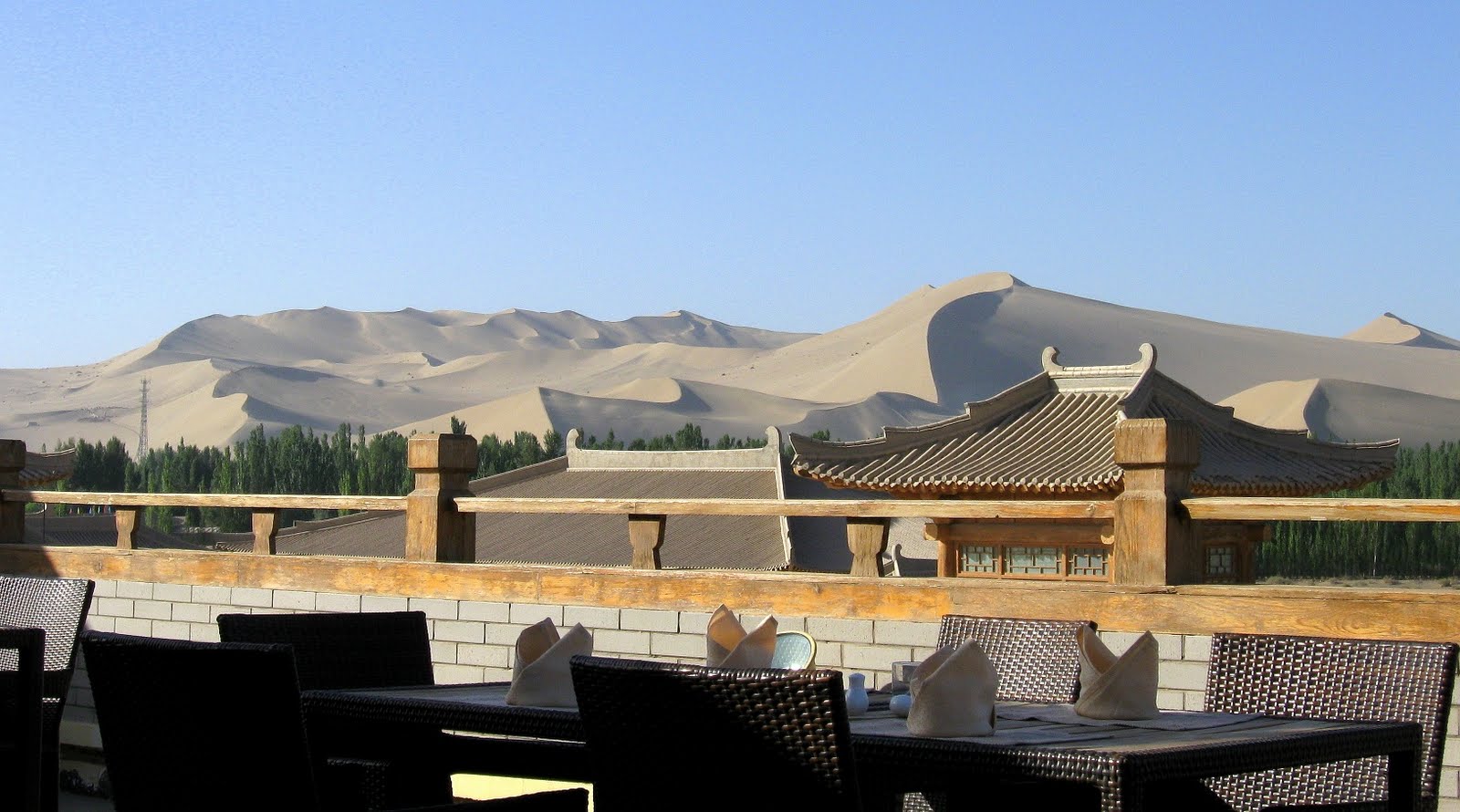
Although popular with tourists, Dunhuang is not crowded and people are quite laid-back, so that we seldom got harassed by vendors. They gentrified city center is also rather small, so you don't feel lost like in Jiayuguan. Some pedestrian streets make it a nice place to stroll and we enjoyed the peace and quiet of the town so much that we stayed longer and mostly just hung out, either on our rooftop cafe (where I submitted my internship application! :)) or in the streets where all the restaurants have tables outside. It's unbearably hot here during daytime, probably reaching 40 degrees, and with the huge sand dunes (Mingshan is 1700m high) in the background one gets a real desert feeling. Since that was not enough, we also went on a 3-day camel ride through the desert.

We started off at 6pm, since it was an especially hot day, starting from our guide's house - Li Shifu (he's also a shifu, but not like my kungfu teacher, he's the skilled-expert kind of shifu) has been doing these kind of tours for almost 30 years. Whereas we came prepared with sunscreen, hats, long (white) clothes and sunglasses, he just set off with a bunch of keys and his cell phone, looking as if he was just going around the corner buying cigarettes. As soon as we had reached the sand dunes, he took off his shoes and walked barefoot, leading Fang Fang, my new best smelly friend for the next few days, on a rope, who was tied to Le Le (our pack camel) and Lin Lin, whose one hump was kinda sagging because her "yin/yang has problems". Unfortunately, the first evening we were joined by a youth camp group of 15 American teenagers and a couple of annoying guys in their twenties who kept trying to impress the teachers. But they went back into town the next morning and we were left alone with Li Shifu and three camels.

Fun part about the desert - watching the sun set over the dunes, with the oasis of Dunhuang in the distance. Not so much fun - getting up at 5:30am to watch the sun rise at 6:30... Why we were woken so early I'll never know, but we were on our way by 7, to avoid the main heat. After not too long the sand became to hot for our guide to walk on, so he tied some sturdy, bright orange platic bags around his feet. These "shoes" also serve as anchors for pretty much anything, from tent to camel, when filled with sand. We also had to rest between 11:00 and 17:00, because it's just too hot.

The desert was surprisingly green - quite a lot of shrubs grow in the sand, which the camels like to chew. Those are really hard branches they bite off and chew down - just to re-chew them the whole day. Supposedly, they can go 10-20 days (depending on heat and desert condition) without food or water, but they were clearly hungry on the second day and tried to grab whatever they could when we passed by. During our siesta the camels were allowed to roam around freely and eat what they liked. They ventured off pretty far, but Li Shifu managed to get them all back. After another night in the desert we got back to his home early the next morning.

And after another hazardous taxi ride to the nearest train station with frequent trains, we're on another night train - back to Lanzhou, from where we have to switch to bus to make our way south across one of the Tibetan autonomous Prefectures, into Sichuan. It's precisely this Tibetan region which after our visit was devastated by mud-slides that killed hundreds of people... about three weeks after we passed through there.

Sunday, August 8, 2010

Jiayuguan, July 12-13

There is only one reason to come here and that's the Great Wall - this is where it all ended, the western most point of the Wall under the Ming dynasty. Jiayuguan has a fortress, which was named UNESCO World Heritage Site in 1987. This seems to have prompted the city to massively invest in tourism, there's a huge park around the fortress, the nearest parking lot is about a km from the entrance, so you first have to make your way through vendors selling mostly knick-knacks, don't expect any food (which we needed badly after biking the 15km there from the city against heavy wind), it seems they learned from the Terracotta warriors... just that the tourists aren't coming. The place was almost empty when we went there, the vendors looked bored, the buggy drivers (who drive you from the parking lot to the fortress) idle... It seems to be the story of the town - abandoned construction sites everywhere, huge avenues, roundabouts with socialist style sculptures in the middle - but no-one there to use it! Almost no traffic to speak of, even in rush hour there's no traffic jam, you almost always get a seat on the bus... Jiayuguan - where socialist living is fun!

The same went for our hotel, but they were friendly and clearly happy to practise the two or three English sentences they knew. They thought we were crazy when we asked to rent bikes though. Thankfully, the Lonely Planet does contain some useful information, and we managed to rent two bikes and ride out to the end of the wall - a place 5km out of town where the Ming Wall suddenly ends at a steep river cliff... it could be a quite impressive sight if it wasn't for the Disney-like fort they built there. It's not even a museum or of any historic or educational value! There are a few fake cannons next to catapults and you can have your picture taken in a supposedly historic costume - if the only keeper of the place shows up. Because, of course, the place was deserted. More abandoned construction projects nearby and blue construction fences that spoil the yellow-brown desert imagery... Disappointed, we rode of in the direction of the fortress, and the best part was probably when we just decided to leave the road and ride through the brush. In the end, we did have to turn back and make our way to the big parking lot. The fortress is quite impressive and just as we got there, a huge storm started. Looking west from the fortress walls, one looks into the Gobi desert, where caravans used to depart for an uncertain journey...

In the evening we wanted to see the sun set over the wall, so we hired a taxi for a round trip. He said he'd wait for us for about half an hour. Poor B. ran up the stairs to the watch tower to see the red sunshine on the snow covered mountains - I had to pass, after only little sleep on the train and the day's bike trip I wasn't running anywhere (also the height, around 2,000m seems to take its toll on my fitness), so we wouldn't let the taxi driver wait too long. Well, when we came out he had left! We hadn't paid him yet, not even half of the agreed fare! So, there we were, a good 10km out of town, and there was nobody else in sight (it was already after 9pm, they had opened the gate for us after our taxi driver talked to the gate keeper). We didn't quite know what to do, we felt bad for "cheating" our driver out of his fare, but when a taxi happened to pass by, we didn't hesitate long and hailed it. Who knows when there would be another one? The driver asked rather perplexed "how did you get out here?" Still no idea what happened to our first driver... too bad we didn't know he had abandoned us, we could have stayed at the wall longer. Without any other tourists around - I wish I could have that experience at the Great Wall stretch close to Beijing - the wall there is much more imposing, several meters high and wide enough for a horse cart. The wall stretch we visited falls into the "is it still restoration or already fake?" category. The fake camel caravan (statues) didn't exactly help...

We did spend half a morning wandering around the market, trying strange fruit and tasty baked goods. People are friendly (they are Hui - Muslim Han Chinese, so not really an ethnic minority - recognizable by the white hats worn by men) and probably quite dumbfounded what brings foreigners to their city. Well... so were we.

Friday, August 6, 2010

Lanzhou, July 9-11

This time we had the soft sleeper car (the difference is not actually the firmness of the berth but the degree of privacy - in soft sleeper cars only four people share one compartment and it has an actual door, whereas in hard sleeper the compartment is open to the hallway - the reason we didn't get much sleep last time, some people went on talking till 1am, others got up at 6... you have to admire the ability of people to make themselves at home in a train car though - they started setting up makeshift tables and playing cards and everybody seems to travel with an inexhaustible supply of raamen noodles, which left us feeling like amateurs with our peanuts... not much for a breakfast when the train is two hours delayed. We abandoned our initial strategy of taking late trains (as we're late sleepers) and arriving not too early and switched to the Chinese schedule - going to bed at 11 and getting up at 6. And it's amazing how much you can get done in a day when you get up at 6 - once we get to the hotel, have showered, had a tea and are relaxed a little it's around 9 or 10 and we have the whole day ahead of us. Admitted, not the fittest of days, at least in my case.

We left Xi'An in pouring rain and arrived in Lanzhou in pouring rain. We were soon consoled, though, because we happened to have picked a really nice hotel (buying train tickets two days in advance and booking hotels on elong seems to work very well) for little money and got upgraded to a room with huge double bed, free standing bathtub and extra shower and all the little knickknacks (like bathrobes, fluffy slippers) you'd expect in a five-star hotel (no idea how many stars they had). A hot foam bath after a night on the train is heavenly :) The hotel also had a really nice decor, full of natural stones, and traditional furniture whose style varied on different floors. The service was over-the-top amazing, which had the effect that we couldn't just wander off somewhere, because someone with a secret-agent style headset would run over to us and ask if we needed help. They even had working internet!

So, we set off to explore Lanzhou, supposedly China's most polluted city - a title I doubt but we might just have had luck with the weather, with umbrella's borrowed from our super-hotel and went in search of a tea house to sit, snack, write and read. The one the Lonely Planet mentions didn't exist anymore, but it was surprisingly easy to find a tea house, i later noticed Lanzhou seems to be full of them. That was a life-time experience :) Not so much in terms of the tea (pretty bad) and food (typical buffet) or decor (kitschy but fitting), but the people! When we got there at 11:30 it was still pretty quiet, but then elderly people started to trickle in and when the lunch buffet was opened at noon there was a stampede to get to the best food (mostly the shrimp) - all-you-can-eat is also very popular in China. 15min later the bowls were wiped clean. One old lady liked the food so much, she took her denture out of her mouth and licked it clean.

The sun started coming out. We left the battle field and headed out into the city, which is really like any other Chinese medium-sized (a few million inhabitants) city, but if you haven't seen one, then how can you know what I'm talking about? Basically, there is a "gentrified" downtown with western style shopping malls and chains like McDonalds and KFC. In smaller side streets you get the cheaper clothes and accessories and the not-yet-gentrified streets typically have grocery or fruit stores, household goods or shoe stores, and street food or noodle shops on the ground floor, with 5-6 storey apartment buildings (probably from the 60s) behind them.The cleanliness and smell of these areas seems to be correlated with the amount of tourists the city gets - Xi'An was the nicest so far (at least inside the city walls), followed by Nanjing, Lanzhou, Jiayuguan. And the farther west we get, the more likely we run into really old neighborhoods without sewage system or even running water (in Lanzhou we witnessed people getting water with plastic containers from a little shed, which I suppose contains a well). Now, I'm all for preserving the old Hutong neighborhoods with the traditional courtyards, such as in Beijing, but those were really just brick huts, more barracks then courtyards. Not far from there new 20-30 storey apartment buildings are growing and I guess it's just a matter of time until those huts are gone - but how are those people supposed to afford living in the new high-rises? It's not like their land now is worth a lot, it's not downtown Beijing, where it's a good deal for the government to give the Hutong residents apartments in the outskirts of town and convert their old homes into museums or tear them down to erect shopping malls (or olympic facilities).

Anyways, after we had made our way through the shopping district and across the Zhong Shan (Sun Yat'sen) Bridge, a masterpiece of Russian-German-Chinese engineering spanning the Yellow River, we climb the hill on the other side, leading to the White Pagoda Park. From there we had amazing views onto the city.Ok, the city is really not amazing, but it's squeezed between two mountain ridges, which gives it its weird, long-stretched form. It was kinda cool to sit in a tea house on top of the hill, which belongs to the Taoist temple, and hear the call of the Muezzin from the Minaret below... There are definitely more Muslims in Lanzhou than in Xi'An or anywhere in eastern China I have been so far, and we expect to see more the further west we get. Also, ethnic minorities become more and more visible, because of their clothing and facial features.

Since we had so much fun eating lamb skewers on the night market in Xi'An, we tried the same thing in Lanzhou - but the night market mentioned by our guide books had already been gentrified. Since it was already quite late, we headed for the nearest noodle shop on a quite dingy-looking unpaved street - after business the restaurants just piled their garbage in the middle of the road. Well, I don't know if you can see where this is going, but the next day we both came down with pretty bad food poising. The second time noodle soup with fried egg was the culprit! I was knocked out so badly, I spent all day in bed - good thing we had booked two nights in our fancy hotel. The hotel service was really attentive (invasive?), they called and asked why we had the "do not disturb" sign outside all day (actually, it's an electric sign, the switch also disables the door bell, so you are completely left in peace... well, until they call you to see if you're not doing anything "illegal, like sex" - quote from the hotel brochure - in your room. when I explained that I was sick, they came and brought me a hot-water bag and "red soup" - a sort of herbal tea, Chinese medicine. I felt somewhat better the next day, but I think that was mostly due to the Western medicine.

The last day we had booked another night train, so we still had a day to kill. None of us felt much like eating, and so we took the cable car up on the other mountain range. The little temple mentioned by the guide books has been expanded into a full-blown park with a fake waterfall and several more pagodas, playgrounds and makeshift tea houses. It seemed still halfway under construction and the large unconcealed garbage heaps here and there were quite a turn-off. But great views...

Noteworthy food - red Chinese dates (Jujube), soaked in wine and served with honey as a cold starter. Tea is often a mixture of green tea with flowers, dried fruit and rock sugar - the same stuff that is sold in Canada (and other places in the west?) at "My Cup of Tea" chain stores... And I always thought they had made this up! Apparently, it's just Western Chinese (or "Muslim" or "8 treasure") tea, I have never seen it in the east. Usually restaurants serve Dragon Well (from Hangzhou) or Bi Luo Chun tea (from Nanjing!)

Sunday, August 1, 2010

Xi'An, July 6-8

Ever since the famous terracotta warriors were unearthed, no tour group can bypass Xi'An. The city isn't quite as cramped with tourists as Hangzhou was, but the proportion of Westerners is so much higher, it makes it very obvious. After a gruelling 14hour train ride (which we involuntarily spent in the hard sleeper - a mistake I only discovered when boarding, it seems most people here assume you want hard sleeper and not soft sleeper, which is just a waste of money) we arrived to clear blue skies and scorching 38 degrees. We're staying in a really cute hostel, it's set in a traditional courtyard home, but equipped with all modernities such as wireless internet, a bar and a restaurant that serves Illy coffee :) The bar also shows the world cup which kept B. up till 4am (the games start at 2:30 Chinese time) - I was so bummed out after a day walking around the Muslim quarter and the city center, I didn't hear a thing. Thankfully I didn't make the effort to stay/get up just to watch Germany lose...

Things we saw:

Gao Jia Da Yuan - the former family residence of the Gao family, the highest ranking officials in Xi'An during the Ming. The buildings date from Ming and Qing dynasty and now house an artist's factory. There are painters, calligraphers and paper cutters and we got a really nice tour of the whole complex. Finally, I understand why there are so many round doors in traditional courtyard homes - square and rectangle represent yang (or male), whereas round and diamond shape represent yin (or female). According to Taoist belief (or Feng Shui as well), you always need your home to be well balanced. Also, these courtyard homes follow a typical layout - first, there is a reception courtyard - official male visitors may be invited into the first hall (mainly for representing), after the second court there is a hall for receiving female guest. Further inward are the living quarters, with the head of the family oriented towards the north (=up=head), the heir of the family following just south-west of there, the concubines live off to the side, the madam of the house sort of central. There is also a "bridal chamber," which really houses the daughter of the family from age 6 till marriage. That's where she learns to sow, maybe play an instrument or do calligraphy (if her father is not too Confucian and reserves those fine arts for men), servants bring her food and she almost never leaves. She lives there with a nanny, who is responsible for the most important beautification - the foot binding. Dear lord. The whole complex is quite well preserved (according to our guide, they survived the cultural revolution by simply shutting the door and being quiet - it was already an artists' residence, not a private home at that time) and a pleasant contrast to the usual over-the-top restored, fake colorful touristy stuff. They did talk us into buying some of their tea (we also got a tea ceremony there, but I had better before - it was really just a sales talk, and not the best one for that matter) - but we'll just consider it consensual mugging :)

The great Mosque - the first mosque I ever visited :) and really not the most representative. It's also set in a Chinese courtyard style, all the buildings look definitely Chinese, and the tower that serves as a minaret could well be a pagoda for a Buddhist temple. In traditional Chinese fashion you have to make your way through several courtyards and at the very end is the main building - the prayer hall. It can house up to 1,000 people, but is closed to tourists.

The City Wall - quite impressive, because it was restored on the full length, so you can walk or bike or hire a buggy to go around the whole city wall. Of course, the part inside the walls is not all of Xi'An, but unfortunately, it's not like historic Xi'An and modern Xi'An are separated by it. What's left of ancient Xi'An (Bell Tower, Drum Tower) is not much. But the walk on the city wall is really nice and they put on a quite spectacular drum performance. Also, it was hot, windy day and you couldn't help but feel like in a Lord of the Ring movie, on the walls of Helm's Deep :)

Temple of the Eight Immortals - that's an active Taoist temple, and I was quite keen on seeing it, because most temples in China seem to be Buddhist. Well, I was in for a surprise, because some of the deities I saw there were old familiars from the Buddhist temple in Nanjing. Our guide from the Gao residence explained to us, that in China Buddhism, Confucianism and Taoism are really interwoven so much (since the Song dynasty, because one religion is better for the state, especially if you get to pick elements such as balance/harmony (from Taoism), and obedience to the state (from Confucianism)), you can't really tell them apart. Most Buddhist temples have some Taoist deities (in contrast to the other two big branches of Buddhism outside India - Tibetan and the one that developed in Yunnan/Laos/Vietnam). So, this temple was special in the sense of that the monks there have distinct clothing and you are only allowed to burn incense with the Taoist yin/yang symbol on it :) Unfortunately, no pictures allowed, I would have loved to take one of a monk. Their uniform is much more what you imagine a Chinese monk in contrast to the Buddhists, who look rather Indian. There is a bridge with a bell on either side and if you manage to hit the Bell with a coin (this explains the bridge - the money falls into the little pit beneath, you cannot just keep trying with the same coin), it expresses your life-long connection to the Tao, something along the lines that you're predestined for Taoism. Well, I, who couldn't hit a horse with a bat if it was right in front of me, managed indeed to hit the Bell and get a satisfying gong (instead of B.'s "clonk" from hitting only the frame) - probably because I had already bought a little jade Buddha and, as a gift, got my name written on a red "lucky paper" and hung on the gift shop wall - it means the Taoist temple grants me one year of luck - I guess after one year you have to come back and buy something else to renew your luck :)

Shanxi History Museum - thanks to the support and never ending glory of the party this museum displays China's greatness and the power of the people with several thousand tri-color glazed ceramic horse figurines. You simply have to be stunned. Especially after standing in line for one hour for a free ticket.

Terracotta warriors - overpriced for 90yuan and somehow disappointing after all the hype. I guess it's enough to see the few they have in the History Museum, you can save yourself the 1-hour trip to the little town. Also, they always advertise the place as there being thousands of statues, but most of them are not excavated. When they open a pit, it's really just a pile of debris and then they have to puzzle it together. But yes, it's huge, it's impressive. What I didn't know before - the underground chambers did not only contain the army, but it was in fact a replica of the whole court. There are two walls - court wall and city wall, so to speak, and there were bronze statues of zoo animals and artifacts for domestic use, as well as some terracotta statues of civil servants. They believe, the emperor expected his reign to live on in the afterlife, so he needed a fully equipped court. Supposedly it took 700,000 workers (many of them forced labour) 37 years to complete the mausoleum, which was planned when he was 13.

Things we ate:

The best thing about Xi'An: fresh, sweet, juicy water melons at every corner. They're so delicious when they're warm from the sun, taste like freshly gathered from the field. Melon juice in restaurants is also quite a treat, especially in this heat. One evening we had shrimps stir-fried with fresh fruit (papaya, pineapple, dragon fruit), although that strikes me as rather nouvelle Chinoise cuisine and not a traditional dish, it hit the spot. A much needed contrast to all the salty, cumin laden meat we ate. Some traditional Xi'An dishes include:

Rou jia mo (meat in bread) - sort of a small sandwich (Doener Kebab for those who had the luck to try the most famous German fast food), but the mo is closer to a cracker than to nan bread. The Chinese stuff it with fat pork, the Muslims with lamb or beef, if you're lucky they also throw in a bit of veggie and some chili sauce. We attempted to find a good one, but gave up after the third.

Yang rou bao mo - this is a mutton soup that is served poured over crumbled bread (mo). In the place we had it, it was rather bland and uninspired and the mo very dry again. They served it with chili sauce an garlic on the side, but that didn't help the clear mutton broth to much more nuanced flavours.

Biang biang rou - smoked meat (usually intestines, such as liver, or sausage), tasty, but as pretty much anything else - salty!

Lamb and beef skewers - very thin slivers of meat, grilled by the dozen, basted with the obligatory cumin-chili mixture (never hot enough for our taste, but we might have reached our cumin limit), we had this with a side of soybeans and boiled peanuts (in the shell) and more dry mo (also topped with salt-cumin-chili), washed down with a couple of beers, sitting outside in a street market, surrounded by locals, struggling to sit on tiny plastic stools that seemed fitting for 3-year olds, and thoroughly enjoyed ourselves.

Saturday, July 3, 2010

Dumpling Manifesto

It's so nice to know that there are like-minded people out there, even if I would never go as far as pick a fight with the chef in a restaurant... not that they wouldn't deserve it, mind you.

Stay tuned from tales from the road - we're off with the night train to Xi'An tomorrow! Let's hope the dumpling there are indeed as good as advertised :)

We had our farewell dinner in a... hold your breath... German restaurant!


Because Xu Feng is going to Germany soon (and hopefully landing a PhD position there), so we thought it would be fun to "teach" him about German food. It was indeed very entertaining, but the food wasn't worth mentioning (good beer, though). Xu Feng likes the Bratwurst, so he should survive his Germany trip just fine :)

And I have to say, it's completely impossible to pack for 2 months in 3 different climate zones! What do I do?!

Saturday, June 26, 2010

Hangzhou

This famous old town is simply beautiful - and totally overran by tourists, who won't even be stopped by pouring rain or unbearable humidity. Thanks to that, though, Hangzhou is lush and green, at least around West Lake, the historic part of town. Briefly, during the Southern Song Dynasty (1127-1279 AD), even China's capital, Hangzhou is mostly known as a city of poets and merchants. There's a Chinese saying - in heaven there's paradise, on earth there's Hangzhou (and Suzhou). That's how beautiful it's supposed to be and that's why it's so popular with Chinese tourists.

We arrived to pouring rain, but the second day was nice and not even too hot for a hike in the hills south of the Lake. That's where the famous Dragon Well tea is from (龙井 Longjing is a small village between West Lake and Qiantang River - a river so big, it's shocking I had never heard of it. It even experiences strong tidal waves, supposedly on every 15th of the month, and lo and behold, we witnessed one).

But first we "hiked" to the tea museum and Longjing village. Not exactly a hike, because most of the way you are forced to share the road with cars and tour buses that are almost bumper-to-bumper all the way, which of course, doesn't stop them from honking all the time, because that's how you drive in China - with the horn, not the gas. I was very happy when we made it to the tea museum, a quiet oasis, and entrance to the beautiful grounds is free! (They make up for it by charging horrendous prices for the tea.) Supposedly, you can get free tea from any inhabitant of Longjing, but we were quiet put off by the inevitable "Hello, hello, tea!" So we ran. And wandered for about an hour through picturesque hills and tea plantations.

Hangzhou

The eastern side of the lake is lined with bars and restaurants that cater to tourists, thankfully our hotel was located a bit south, away from the crowds. Elong.com ("electronic dragon"), the Chinese version of expedia, is a good resource for travel booking, I already used it for my trip to Hainan. We did make good use of the fancy hotels there, though - we went to the Hyatt for dinner and had the probably best chicken of our lives. It's called "beggar's chicken" (and my Chinese friends think we're crazy for going to a fancy restaurant to eat this, but I still believe it was worth it - the chicken was organic) and is basically a whole chicken, that is stuffed with mushrooms and bacon, drenched in a tasty wine-soy sauce, wrapped in lotus leaves, packed in clay and then baked. So, it's steaming in it's own juices, that can't evaporate because the clay is air tight, and it absorbs all the flavours, also that of the lotus leaves. Of course it was served with a lot of tam-tam, i.e. a hammer to break the clay crust (for good luck). Oh my, it was so succulent and the meat so tender, just falling of the bones... I'm getting hungry again writing about it. After that, we foolishly shared their special dessert platter that contained concoctions such as green tea creme brulee (which I had before and was not a big fan of, but this one convinced me otherwise - the key is to not make it too sweet but let the slight bitterness of the tea dominate), a Jasmin Tiramisu, Grand-Marnier parfait served in an orange and Lotus puff pastry. We left the restaurant positively stuffed and happy :)

The next day we needed to recover, so we just did a little walk around the lake (12km), marveling at all the tourists that go to the most famous bridges (such as the lover's suicide bridge or the "broken bridge", which looks like it's broken if there is snow on it, because the snow doesn't stay on a small stretch in the middle). We had planned on taking a bus back that evening, but when I checked (ehm, that means sending an SMS to one of my helpful students ;-)), it turned out there was none that evening - it was Duanwujie (dragon boat festival) and therefore a holiday. I think this was really the first time I appreciated not being a poor student anymore (and moreover living in a relatively cheap country), because it was no problem to go back to our hotel and say we want to stay another night.

The last day we went to the famous Fajing Temple complex. Apart from the main temple there are also smaller ones scattered throughout the hills and quite impressive stone carvings of buddhas in the hillsides, dating as far back as Tang Dynasty (618-907 AD).
West Lake and Peak Flying from Afar

We relaxed with another cup of the local tea when it started raining again and we had to head back to the bus station... of course, we missed the bus we had booked because we got stuck in rush hour traffic, but fortunately there was another one just half an hour later. This time we even had comfortable seats and arrived back home in good spirits 3 1/2 hours later.

I guess this can be seen as our first test run for travel in China. Valuable lessons learned:
  • buy your return or onward ticket as soon as you arrive, because often they are only sold at the train/bus station, which might be several km out of town.
  • noble hotels might still be a bit expensive at around $100/night, but they are invaluable as god dining resources (you need an excellent food buddy such as B. though :-))
  • stay away from cocktails, even in pricy bars
  • be flexible with your itinerary, i.e. always be prepared to have to stay another night
  • there's nothing that can not be done over the internet in China!
Hopefully, I'll remember those when we start out silk road trip - we're leaving July 5th, heading to Xi'An, where we want to stay three days, then to Lanzhou and southern Gansu... and then we'll see!

On a totally unrelated note... more pictures from Nanjing, taken on an amazingly clear day - we have only had haze, smog and humid 34 degrees since we got back from Hangzhou.

More of Nanjing